The “Ghost” of Guantánamo is Freed; Ridah Al-Yazidi, Never Charged, Held Since Day One, and Approved for Release 15 Years Ago

Please support my work as a reader-funded journalist! I’m currently trying to raise $2500 (£2000) to support my writing and campaigning on Guantánamo and related issues over the next three months. If you can help, please click on the button below to donate via PayPal. Please also consider taking out a free or paid subscription to my new Substack newsletter.
In welcome news, the Pentagon has announced that it has repatriated from Guantánamo Ridah Al-Yazidi, 59, a Tunisian prisoner held without charge or trial since the very first day of the prison’s operations nearly 23 years ago, on January 11, 2002.
Although almost completely unknown to the outside world, because of the mainstream media’s persistent lack of interest in investigating the mundane lawlessness of so much of the prison’s operations, Al-Yazidi’s case is one of the most outstanding cases of casual injustice at Guantánamo.
Along with two other men who are still held, he was approved for release 15 years ago, through the deliberations of the high-profile Guantánamo Review Task Force, comprising officials drawn from various government departments and the intelligence agencies, who met once a week throughout 2009 to administratively decide the fate of the 240 prisoners that President Obama had inherited from George W. Bush.
Guantánamo Scandal: Eleven Men Were Set to Be Freed Last October, Until “Political Optics” Shifted After Hamas’ Attack on Israel

Please support my work as a reader-funded journalist! I’m currently trying to raise $2500 (£2000) to support my writing and campaigning on Guantánamo and related issues over the next three months. If you can help, please click on the button below to donate via PayPal.
I wrote the following article for the “Close Guantánamo” website, which I established in January 2012, on the 10th anniversary of the opening of Guantánamo, with the US attorney Tom Wilner. Please join us — just an email address is required to be counted amongst those opposed to the ongoing existence of Guantánamo, and to receive updates of our activities by email.
Thanks to NBC News, and the four anonymous US government officials who spoke to them, for exposing the latest scandal involving the US prison at Guantánamo Bay — the refusal of the Biden administration to release eleven men, for whom long months of negotiation had secured a safe and viable resettlement option, because of the perceived “political optics” of freeing them after the attacks on Israel by Hamas and other militants on October 7.
Within Guantánamo circles, this scandal was well known, but attorneys for the men had been subjected to a Protective Order issued by the government, preventing them from talking about it, and, as a result, they had all dutifully kept quiet, as had others, like myself, who had got to know about it.
Their silence is, in itself, an indictment of how the US government operates at Guantánamo, as I also recognised when I refused to publicize it, because of the fundamentally lawless situation in which these men are held.
Held for 900 Days Since Being Approved for Release from Guantánamo: Sanad Al-Kazimi, a Yemeni Torture Victim

Please support my work as a reader-funded journalist! I’m currently trying to raise $2500 (£2000) to support my writing and campaigning on Guantánamo and related issues over the next three months. If you can help, please click on the button below to donate via PayPal.
Today marks 900 days since Sanad al-Kazimi, a 54-year old Yemeni, and a father of four, was unanimously approved for release from Guantánamo by a Periodic Review Board, a high-level US government review process established under President Obama.
This article, telling his story, is the ninth in an ongoing series of ten articles, published since early February, telling the stories of the 16 men (out of 30 still held at Guantánamo in total) who have long been approved for release. The articles are published alternately here and on the Close Guantánamo website, with their publication tied into significant dates in their long ordeal.
While most of the 779 men held at Guantánamo since it opened over 22 years ago were picked up — or bought — in Afghanistan or Pakistan and processed through military prisons in Afghanistan before their arrival at Guantánamo (mostly between December 2001 and November 2003), al-Kazimi was one of around 40 prisoners whose arrival at Guantánamo involved a more circuitous route, through the network of CIA “black sites” established and run in other countries between March 2002 and September 2006, and, in some cases, in proxy prisons in other countries run on behalf of the CIA.
Held for 600 Days Since Being Approved for Release from Guantánamo: Khaled Qassim, a Talented Artist

Please support my work as a reader-funded journalist! I’m currently trying to raise $2500 (£2000) to support my writing and campaigning on Guantánamo and related issues over the next three months. If you can help, please click on the button below to donate via PayPal.
Sunday (March 10) marked 600 days since Khaled Qassim (aka Khalid Qasim), a 47-year old Yemeni, was unanimously approved for release from Guantánamo by a Periodic Review Board, a high-level US government review process.
That decision took place on July 19, 2022, but nearly 20 months later Khaled is still awaiting his freedom, a victim, like the 15 other men unanimously approved for release by high-level US government review processes, of an inertia at the very top of the US government — in the White House, and in the offices of Antony Blinken, the Secretary of State.
For the last year and a half, an official in the State Department — former ambassador Tina Kaidanow — has been working on resettling the men approved for release, most of whom, like Khaled, are Yemenis, and cannot be sent home because of a ban on their repatriation, inserted by Republicans into the annual National Defense Authorization Act in the early days of Barack Obama’s presidency, and renewed every year since.
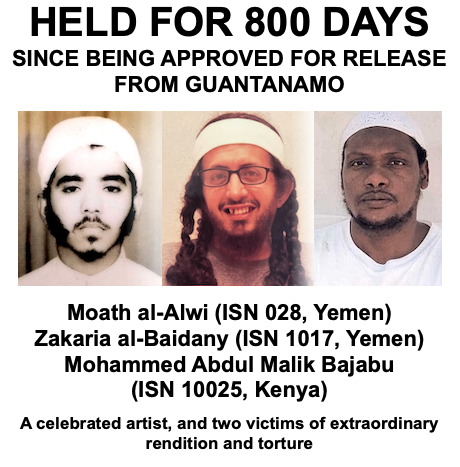
Held for 800 Days Since Being Approved for Release from Guantánamo: Moath Al-Alwi, Zakaria Al-Baidany and Mohammed Abdul Malik Bajabu
Please support my work as a reader-funded journalist! I’m currently trying to raise $2500 (£2000) to support my writing and campaigning on Guantánamo and related issues over the next three months. If you can help, please click on the button below to donate via PayPal.
This is the fifth in a new series of ten articles, alternately posted here and on the Close Guantánamo website, telling the stories of the 16 men still held at Guantánamo (out of 30 men in total), who have long been approved for release from the prison by high-level US government review processes, but have no idea of when, if ever, they will actually be freed. The first four articles are here, here, here and here.
Shamefully, these men are still held because the reviews were purely administrative, meaning that no legal mechanism exists to compel the US government to free them, if, as is apparent, senior officials are unwilling to prioritize their release.
To be fair, most of these men cannot be repatriated, because of US laws preventing the return of men from Guantánamo to countries including Yemen, where most of the men are from, but if senior officials — especially President Biden and Antony Blinken — cared enough, these men would already have been freed, and the suspicion, sadly, must be that they are failing to do anything because the they don’t want to upset the handful of Republican lawmakers who are fanatical in their support for Guantánamo’s continued existence, while they seek the GOP’s cooperation in funding military support for Israel and Ukraine.
Held for 5,150 Days Since Being Approved for Release from Guantánamo: Toffiq Al-Bihani and Two “Ghosts,” Ridah Al-Yazidi and Muieen Abd Al-Sattar

Please support my work as a reader-funded journalist! I’m currently trying to raise $2500 (£2000) to support my writing and campaigning on Guantánamo and related issues over the next three months. If you can help, please click on the button below to donate via PayPal.
Three weeks ago, I began a new Guantánamo project, telling the stories of the 16 men who have been approved for release from the prison, in an effort to humanize them, to remind the world of their existence, and to highlight the disgracefully long amount of time that they have been held since being approved for release.
I’m alternating publication of the articles here and on the Close Guantánamo website, tying them in to noteworthy dates relating to how long they have been held since the US authorities first decided that they no longer wanted to hold them. The first article focused on the case of Uthman Abd Al-Rahim Muhammad Uthman, a Yemeni who, on February 7, had been held for 1,000 days since being approved for release, and the second focused on Hani Saleh Rashid Abdullah, another Yemeni, who, on February 11, had been held for 1,200 days since being approved for release. For the fourth article, about Abdulsalam Al-Hela and Sharqawi Al-Hajj, see here.
The reason these men have been held for so long without being freed is, sadly, because the decisions taken to release them — via Periodic Review Boards, a parole-type review process established by President Obama in 2013 — were purely administrative, meaning that the US government has no legal obligation to free them, and they cannot, for example, appeal to a judge to order their release if, as has become sadly apparent, the government has failed to prioritize their release.
UN Condemns 21-Year Imprisonment of Abu Zubaydah as Arbitrary Detention and Suggests that Guantánamo’s Detention System “May Constitute Crimes Against Humanity”

Please support my work as a reader-funded journalist! I’m currently trying to raise $2500 (£2000) to support my writing and campaigning on Guantánamo and related issues over the next three months. If you can help, please click on the button below to donate via PayPal.
In what strikes me as the single most devastating condemnation by an international body that has ever been issued with regard to the US’s detention policies in the “war on terror” — both in CIA “black sites” and at Guantánamo — the UN Working Group on Arbitrary Detention has declared that the 21-year imprisonment of Zain al-Abidin Muhammad Husayn, better known as Abu Zubaydah, constitutes arbitrary detention, via the flagrant abuse of the relevant articles of the Universal Declaration of Human Rights, and the International Covenant on Civil and Political Rights, and has expressed “grave concern” that the very basis of the detention system at Guantánamo — involving “widespread or systematic imprisonment or other severe deprivation of liberty in violation of fundamental rules of international law” — “may constitute crimes against humanity.”
The UN also condemned other countries for their involvement in Abu Zubaydah’s arbitrary detention — specifically, Pakistan, where he was first seized, Thailand, Poland, Morocco, Lithuania and Afghanistan, where he was held and tortured in CIA ”black sites”, and the UK as “a State complicit in the extraordinary rendition programme that knowingly took advantage of it” (as discussed in a secret detention report by the UN in 2010, on which I was the lead author).
As the Working Group also explains, with reference to the British government, “The Intelligence and Security Committee of Parliament (United Kingdom) found, in 2018, that the Government had sent questions to interrogators and received intelligence obtained from detainees who the authorities knew or should have known had been mistreated. The parliamentary inquiry found that the United Kingdom had been directly aware of Mr. Zubaydah’s ‘extreme mistreatment,’ yet its intelligence agencies had provided questions for his interrogation.”
Saudi Engineer Ghassan Al-Sharbi Sent Home From Guantánamo; 31 Men Remain, 17 Approved For Release

Please support my work as a reader-funded journalist! I’m currently trying to raise $2500 (£2000) to support my writing and campaigning on Guantánamo and related issues over the next three months. If you can help, please click on the button below to donate via PayPal.
I’m pleased to report more good news from Guantánamo as Ghassan Al-Sharbi, a Saudi prisoner held for nearly 21 years, has been repatriated. 48 years old, he was just 28 when he arrived at the prison on June 19, 2002.
Al-Sharbi was seized on March 28, 2002, during a number of house raids in Faisalabad, Pakistan, which also led to the capture of Abu Zubaydah, for whom the CIA’s post-9/11 torture program was first developed, in the mistaken — one might even, more appropriately, say deluded — belief that he was a high-ranking member of Al-Qaeda.
Al-Sharbi’s classified military file, released by WikiLeaks in 2011, suggests that he was seized in a guesthouse known as the Aldafa guesthouse, which analysts alleged to be “one of two guesthouses that was ran [sic] by Abu Zubaydah in Faisalabad,” although Al-Sharbi stated that a man named Ahmed “was in charge of the day-to-day operations of the house, not Abu Zubaydah as is sometimes reported.”
Great News As The Rabbani Brothers Are Freed From Guantánamo and Sent Home to Pakistan; 18 Others Approved for Release Must Now Also Be Freed

Please support my work as a reader-funded journalist! I’m currently trying to raise $2500 (£2000) to support my writing and campaigning on Guantánamo and related issues over the next three months. If you can help, please click on the button below to donate via PayPal.
On Thursday, the US authorities confirmed that two Pakistani brothers in Guantánamo — Ahmed Rabbani, 53, and his elder brother Abdul Rahim, 55 — had been freed from Guantánamo and sent home to Pakistan.
Both men had been held by the US for over 20 years. Seized in their home city of Karachi in September 2002, they had been held and tortured in CIA “black sites” for 545 days before being sent to Guantánamo in September 2004, where they had been held ever since without charge or trial.
As Carol Rosenberg noted for the New York Times, which has just published the story of their release, a day after it was broken on social media by former prisoner Mansoor Adayfi, the US authorities claimed that it was holding the brothers “for helping to operate safe houses where suspected operatives of Al Qaeda holed up after the Sept. 11, 2001, attacks.”
Shocking Statistics From Guantánamo: How Long Prisoners Approved for Release Have Been Waiting to Be Freed

Please support my work as a reader-funded journalist! I’m currently trying to raise $2500 (£2000) to support my writing and campaigning on Guantánamo and related issues over the next three months. If you can help, please click on the button below to donate via PayPal.
Last week, when Majid Khan was freed from Guantánamo, it had taken 337 days for the US government to secure his release after his terrorism-related military commission sentence ended, on March 1, 2022.
The US government worked hard to secure Majid Khan’s resettlement in Belize because it was legally required to do so, and also because officials in various branches of the government wanted to ensure the continuing viability of plea deals for Guantánamo prisoners accused of acts of terrorism.
In contrast, however, as the infographic above shows, 20 other men approved for release through high-level government review processes have, for the most part, been waiting far longer than the 337 days that Majid Khan had to wait for his freedom.











 Who's still at Guantánamo?
