Not Fit for Purpose: The Ongoing Failure of Guantánamo’s Military Commissions

Please support my work! I’m currently trying to raise $2800 (£2100) to support my writing and campaigning on Guantánamo for the next three months.
In the 15 years since the terrorist attacks of September 11, 2001, the United States has systematically undermined many of the key values it claims to uphold as a nation founded on and respecting the rule of law, having embraced torture, indefinite imprisonment without charge or trial, trials of dubious legality and efficacy, and extra-judicial execution.
The Bush administration’s torture program — so devastatingly exposed in the executive summary of the Senate Intelligence Committee’s report into the program, published in December 2014 — no longer exists, but no one has been held accountable for it. In addition, as the psychologist and journalist Jeffrey Kaye has pointed out, although ostensibly outlawed by President Obama in an executive order issued when he took office, the use of torture is permitted, in particular circumstances, in Appendix M of the Army Field Manual.
When it comes to extrajudicial execution, President Obama has led the way, disposing of perceived threats through drone attacks — and although drones were used by President Bush, it is noticeable that their use has increased enormously under Obama. If the rendition, torture and imprisonment of those seized in the “war on terror” declared after the 9/11 attacks raised difficult ethical, moral and legal questions, killing people in drone attacks — even in countries with which the US is not at war, and even if they are US citizens — apparently does not trouble the conscience of the president, or the US establishment as a whole. Read the rest of this entry »
Alleged Al-Qaida Bomb-Maker Faces Periodic Review Board at Guantánamo
 Last Thursday, Jabran al-Qahtani, a Saudi national, became the 39th prisoner to face a Periodic Review Board at Guantánamo.
Set up in 2013 to review the cases of all the prisoners who were not facing trials (just ten men) or the rather larger group of men who had already been approved for release by the high-level inter-agency Guantánamo Review Task Force that President Obama established shortly after taking office in 2009, the PRBs involve representatives of the Departments of State, Defense, Justice and Homeland Security, as well as the office of the Director of National Intelligence and the Office of the Joint Chiefs of Staff, and, since January 2014, they have approved 22 men for release and have defended the ongoing imprisonment of just seven men, a success rate for the prisoners of 76%.
The results are a damning verdict on the task force’s decision to describe 41 men facing PRBs as “too dangerous to release,” even though the task force members also acknowledged that insufficient evidence existed to put them on trial; in other words, it was not evidence, but unreliable information extracted from prisoners at Guantánamo and elsewhere in the “war on terror” — including the CIA’s “black sites” — through the use of torture, other forms of abuse or bribery (with better living conditions, for example). It has also become apparent that another reason some prisoners were described as “too dangerous to release” was because the authorities regarded them as having a threatening attitude towards the US, even though it is, to my mind, understandable that some men confronted with long years of abusive and generally lawless detention might react with anti-social behavior and threats. Read the rest of this entry »
“America’s Shame,” Rolling Stone’s Detailed – and Damning – Article About Guantánamo
 As all eyes are focused on Iowa, on the first caucus of this year’s Presidential election race, I thought I’d cross-post an interesting article about Guantánamo that was recently published in Rolling Stone, written by Janet Reitman. This is a long and detailed article, taking as its springboard a visit to one of the pre-trial hearings in Guantánamo’s military commissions, the alternative trial system set up for the “war on terror,” at the particular instigation of Dick Cheney and his legal adviser David Addington, which seems able only to demonstrate, in its glacially slow proceedings, that it is unable to deliver justice.
I confess that, in recent years, I have rather taken my eye off the military commissions, although I commend those who still visit Guantánamo to write about them, chief amongst whom is Carol Rosenberg of the Miami Herald. I put together a detailed list of who has been charged — plus the eight convictions and the four verdicts that have subsequently been overturned — two years ago, and in that article I stated:
I’ve been covering the commissions since 2006, and I have never found that they have established any kind of legitimacy, compared to federal courts, where crimes should be tried. This conclusion has only been strengthened in recent years, as conservative appeals court judges in Washington D.C. have overturned two of the eight convictions on the basis that they were for war crimes that were invented by Congress rather than being internationally recognized.
Despite His Conviction Being Quashed Three Times, Guantánamo Prisoner Ali Hamza Al-Bahlul Remains in Solitary Confinement
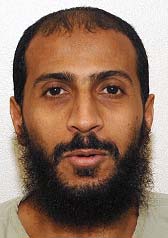 For some prisoners held in the “war on terror” prison at Guantánamo Bay, it seems there really is no way out. One example would seem to be Ali Hamza al-Bahlul, a 45-year old Yemeni prisoner and a propagandist for al-Qaeda, who made a promotional video glorifying the attack on the USS Cole in October 2000, in which 17 US soldiers died, and who received a life sentence for providing material support for terrorism, conspiring with al-Qaeda and soliciting murder after a one-sided military commission trial in the dying days of the Bush administration.
Al-Bahlul has been held in solitary confinement ever since — on what is known as “Convicts’ Corridor,” according to Carol Rosenberg of the Miami Herald, even though, since January 2013, he has had every part of his conviction overturned in the US courts — most recently in a ruling by the appeals court in Washington D.C. (the D.C. Circuit Court) on June 12.
In January 2013, a three-judge panel in the D.C. Circuit Court overturned the material support and solicitation convictions, on the basis that the charges of which he was convicted were not recognized as war crimes at the time he was accused of committing them; or, to put it another way, that they had been invented as war crimes by Congress. That ruling drew on a ground-breaking ruling by the D.C. Circuit Court three months earlier, overturning the material support conviction against another man, Salim Hamdan, a driver for Osama bin Laden who was freed in December 2008. The decision in al-Bahlul’s case was confirmed by a full panel of judges in July 2014, and the judges last month overturned the conspiracy conviction — on the basis that conspiracy is not a crime under the international law of war. Read the rest of this entry »
A Few Surprises in the New Guantánamo Prisoner List
 I wrote the following article for the “Close Guantánamo” website, which I established in January 2012 with US attorney Tom Wilner. Please join us — just an email address is required to be counted amongst those opposed to the ongoing existence of Guantánamo, and to receive updates of our activities by email.
On February 20, my friend and colleague, the investigative journalist Jason Leopold, published a prisoner list from Guantánamo, which he had just obtained from the Pentagon, and which had not previously been made public.
The list, “71 Guantánamo Detalnees Determined Eligible to Receive a Periodic Review Board as of April 19, 2013,” identifies, by name, 71 of the 166 prisoners who were held at the time, and, as Jason explained in an accompanying article: Read the rest of this entry »
Two Sudanese Prisoners Released from Guantánamo, 79 Cleared Prisoners Remain
 As the 12th anniversary of the opening of the “war on terror” prison at Guantánamo Bay approaches (on January 11, 2014), the run of good news regarding the situation at the prison continues, with the news that two prisoners — Ibrahim Idris, 52, and Noor Uthman Muhammed, 51, have been released to Sudan, and the Senate has voted to ease restrictions imposed by Congress over the last three years. The release of the two men brings the number of prisoners released this year to eight, and the total number of prisoners still held to 158.
Until recently, there had been three years of inaction regarding Guantánamo, when just five prisoners were released by President Obama. This inaction had been caused because of opposition in Congress and the president’s refusal to spend political capital overcoming that opposition. Of the five men released, two — Ibrahim al-Qosi and Omar Khadr — were amongst the handful of prisoners regarded as so significant that they had been put forward for military commission trials, and had agreed to plea deals that stipulated how much longer they should be held, and three — an Algerian and two Uighurs, Muslims from China’s Xinjiang province — had their release ordered by a US judge, after they had their habeas corpus petitions granted (before the appeals court in Washington D.C. rewrote the habeas rules, so that no prisoner could be released through a legal challenge).
The three years of inaction came to an end in August, when two Algerian men — Nabil Hadjarab and Mutia Sayyab — were released, who, like over half the men still held, had been cleared for release by a high-level, inter-agency task force that President Obama appointed shortly after taking office in 2009. Their release followed a promise to resume releasing prisoners that President Obama made in a major speech on national security issues in May. Read the rest of this entry »
Former Guantánamo Prisoner David Hicks Appeals His 2007 Conviction for Non-Existent War Crime
 Ever since the conservative court of appeals in Washington D.C. delivered an extraordinary ruling last October, vacating one of the only convictions in the military commission trial system introduced for prisoners at Guantánamo, it has only been a matter of time before other appeals would be lodged.
Last Tuesday, November 5, the first man convicted in the trials — the Australian citizen David Hicks, who agreed to a plea deal in March 2007, on the basis that he would be returned to Australia to serve a seven-month sentence — lodged an appeal with the US Court of Military Commission Review, “arguing for a summary dismissal of the conviction,” as the Sydney Morning Herald described it, “because the offence was not a war crime at the time Mr. Hicks was detained, and his guilty plea was made under duress because of his detention, torture and abuse at Guantánamo.”
Just seven convictions have been secured in Guantánamo’s military commission system (between March 2007 and February 2012), which has struggled — and failed — to achieve any kind of credibility since George W. Bush’s Vice President, Dick Cheney, ill-advisedly dragged the commissions from the history books in November 2001. Ruled illegal by the Supreme Court in June 2006, they were then revived by Congress, and revived by Congress a second time under President Obama in 2009, despite warnings by senior administration lawyers that convictions would almost certainly be overturned on appeal. Read the rest of this entry »
US Military Admits Only 2.5 Percent of All Prisoners Ever Held at Guantánamo Will Be Tried
 So it’s official, then. Eleven and a half years after the “war on terror” prison opened at Guantánamo, the maximum number of prisoners that the US military intends to prosecute, or has already prosecuted, is 20 — or just 2.5 percent of the 779 men held at the prison since it opened in January 2002.
The news was announced on Monday June 10 by Army Brig. Gen. Mark Martins, the chief prosecutor for the military commissions at Guantánamo, and it is a humiliating climbdown for the authorities.
When President Obama appointed an inter-agency task force to review the cases of the remaining Guantánamo prisoners, which issued its report in January 2010, the task force recommended that 36 of the remaining prisoners should be tried.
Just five of the 36 have since been to trial — one in the US, and four through plea deals in their military commissions at Guantánamo. Another man — Ali Hamza al-Bahlul — had already been tried and convicted, in the dying days of George W. Bush’s second term, and two others had been sent home after their trials — David Hicks after a plea deal in March 2007, and Salim Hamdan after a trial in July 2008 — making a total of 39 prosecutions, or intended prosecutions, after eleven and a half years of the prison’s existence. That was just 5 percent of the men held throughout Guantánamo’s history, but now that figure, which was, in itself, an extremely poor reflection on the efficacy of the prison and its relationship to any acceptable notions of justice, has been halved.
As Reuters described it, Brig. Gen. Martins explained that the number set by the task force was “ambitious” in light of two rulings last October and in January this year by judges in the court of appeals in Washington D.C. Read the rest of this entry »
Conservative Judges Demolish the False Legitimacy of Guantánamo’s Terror Trials
 When is a war crime not a war crime? When it is invented by the executive branch and Congress, and implemented for six years until a profoundly Conservative appeals court strikes it down.
The invented war crime is “providing material support to terrorism,” and on October 16, 2012, a panel of three judges in the D.C. Circuit Court (the Court of Appeals in Washington D.C.) threw out the conviction of Salim Hamdan, a driver for Osama bin Laden, who had received a five and a half year sentence for “providing material support to terrorism” at the end of his trial by military commission in August 2008 (although he was freed just five months later, as his sentence included time already served).
In its ruling, the court stated, “When Hamdan committed the conduct in question, the international law of war proscribed a variety of war crimes, including forms of terrorism. At that time, however, the international law of war did not proscribe material support for terrorism as a war crime.”
For anyone who has followed the history of the military commissions in any depth, the result was not completely unexpected. Revived by the Bush administration in November 2001, specifically for trying prisoners seized in the “war on terror,” the commissions were struck down by the Supreme Court in June 2006, but were then revived by Congress, when “providing material support to terrorism” and “conspiracy” were included as war crimes, even though there was no precedent for doing so. Read the rest of this entry »
Eleven Years After 9/11, Guantánamo Is A Political Prison
 Eleven years since the terrorist attacks on September 11, 2001, the majority of the remaining 168 men in Guantánamo are not held because they constitute an active threat to the United States, but because of inertia, political opportunism and an institutional desire to hide evidence of torture by US forces, sanctioned at the highest levels of government. That they are still held, mostly without charge or trial, is a disgrace that continues to eat away at any notion that the US believes in justice.
It seems like an eternity since there was the briefest of hopes that George W. Bush’s “war on terror” prison at Guantánamo would be shut down. That was in January 2009, but although Barack Obama issued an executive order promising to close Guantánamo within a year, he soon reneged on that promise, failing to stand up to Republican critics, who seized on the fear of terrorism to attack him, and failing to stand up to members of his own party, who were also fearful of the power of black propaganda regarding Guantánamo and the alleged but unsubstantiated dangerousness of its inmates.
The President himself also became fearful when, in January 2010, the Guantánamo Review Task Force, which he himself had appointed, and which consisted of career officials and lawyers from government departments and the intelligence agencies, issued its report based on an analysis of the cases of the 240 prisoners inherited from George W. Bush (PDF). The Task Force recommended that, of the 240 men held when he came to power, only 36 could be prosecuted, but 48 others were regarded as being too dangerous to release, even though insufficient evidence existed to put them on trial. Read the rest of this entry »












 Who's still at Guantánamo?
